
The GUI of GasDynCalc has been updated. Hopefully, we will release it before New Year. We are planning now to verify all implemented devices.
Update on March 14, 2022
GasDynCalc is still on developing stage. We integrated GUI for two modes: stand alone and network. The stand alone mode is designed to calculate separate parts, such as duct, diffuser, heat exchanger, etc. The network mode is created to model the network of different devices.
Update on October 30, 2020
Currently, we are developing two codes: CFxD and GasDynCalc. We do not actively develop GTECalc. It has been tested and released. The basic functions are integrated and it is free to use. Since there is no any comments from users we do not have the plans to integrate advanced features.
GasDynCalc (update, October 30, 2020)
We decided to summarize the current state of GasDynCalc development.
- GUI: on process,
- Duct: basic functions,
- Diffuser: basic functions,
- Confuser: basic functions,
- Heat exchanger: basic functions,
- Compressor: basic functions,
- Porous structure: basic functions,
- Measurement Venturi: on process,
- Control valve: on process,
- Measurement Orifice: on process,
- Ejector: on process,
- Nozzle: basic functions,
- Turbo-expander: on process,
- Turbine: basic functions,
- Dryer: on process,
- X-Element: on process.
GasDynCalc (update, October 29, 2020)
The basic calculation for converged nozzle has been implemented. The diffuser and confuser had been implemented before. We will continue to work for this program.
CFxD (update, September 18, 2020)
After a long thought we decide to develop CAD engine ourselves to avoid a dependence on 3rd party. Now, we are busy with selection module as the mathematical way is not convenient. So, we are trying to use OpenGL features.
CFxD (update, May 1, 2020)
We tried all month to move to CAD engine Open Cascade. Unfortunately, it seems that it is not possible as we want to have a direct access to the key features. So, we are still thinking if we need to use a third-side engine to accelerate our development.
GasDynCalc (update 02.02.2020)
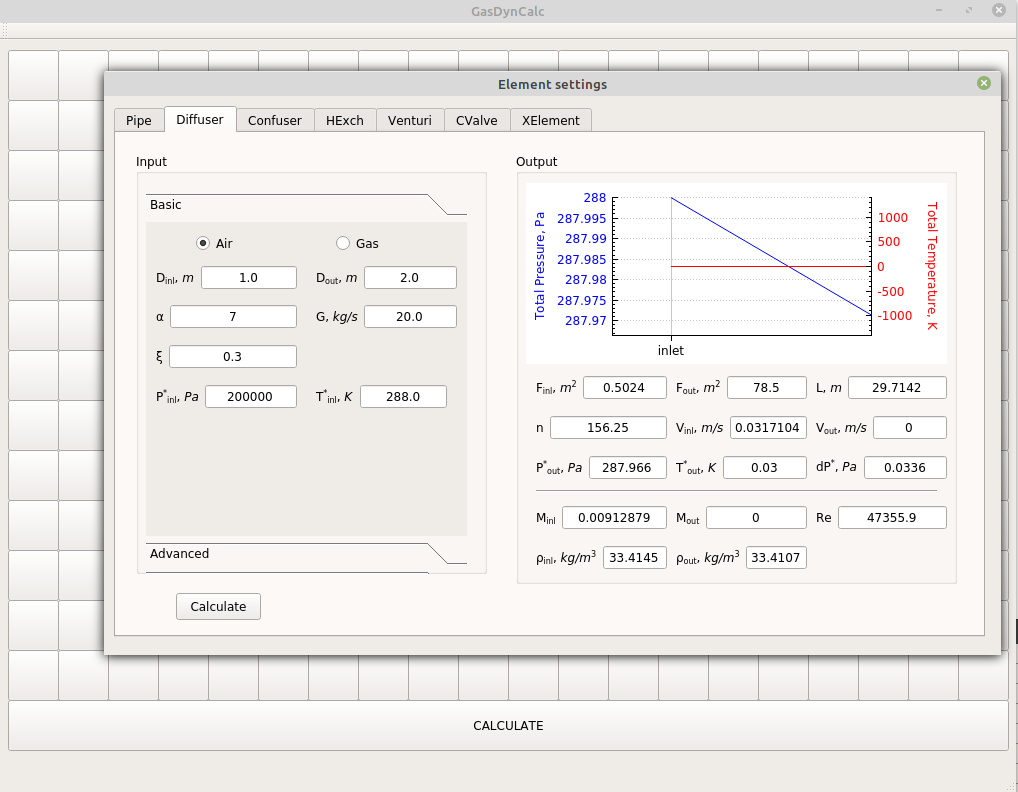
We got some progress in GasDynCalc. The GUI and main strategy are defined. Some parts have been already implemented. We will continue to work on it. Below there is a GUI of pre-alfa version.
GTECalc (update 01.10.2020)
We updated manual. The installer for Windows has been added. Now, it can be installed as a usual Windows program. The updated program (ver. 1.0.1) is here.
GasDynCalc
We started to develop a new code to calculate pipes, valves, measurements elements, etc. connected in one network. It will be able to use for designing pipelines, experimental test cells, HVAC, etc.