Steps
- In the Setup tab, click a domain or its material under Domains to open Domain properties.
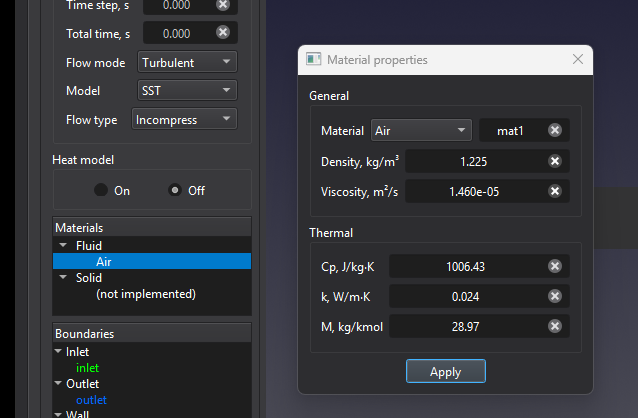
- Use Domain to select the domain to edit. Check its Fluid or Solid role as appropriate to the simulation.
- Choose a library material in Material. To create a custom material, choose New →, enter a name in the adjacent field, and fill in the required properties.
- For a fluid, choose Viscosity model. Newtonian uses a constant kinematic viscosity. Power law uses a viscosity that varies with shear rate and requires the minimum and maximum dynamic viscosity, consistency index m, and flow index n.
- Review the enabled Flow and Thermal fields in the displayed units, then click Apply. Repeat for other domains as needed.
The image shows Air in a fluid domain with Turbulent flow, incompressible Flow type, and Heat model Off. Newtonian is selected; Power law is disabled because the flow is turbulent. Density and Viscosity are active, while Cp, k, and M are inactive for this configuration.